
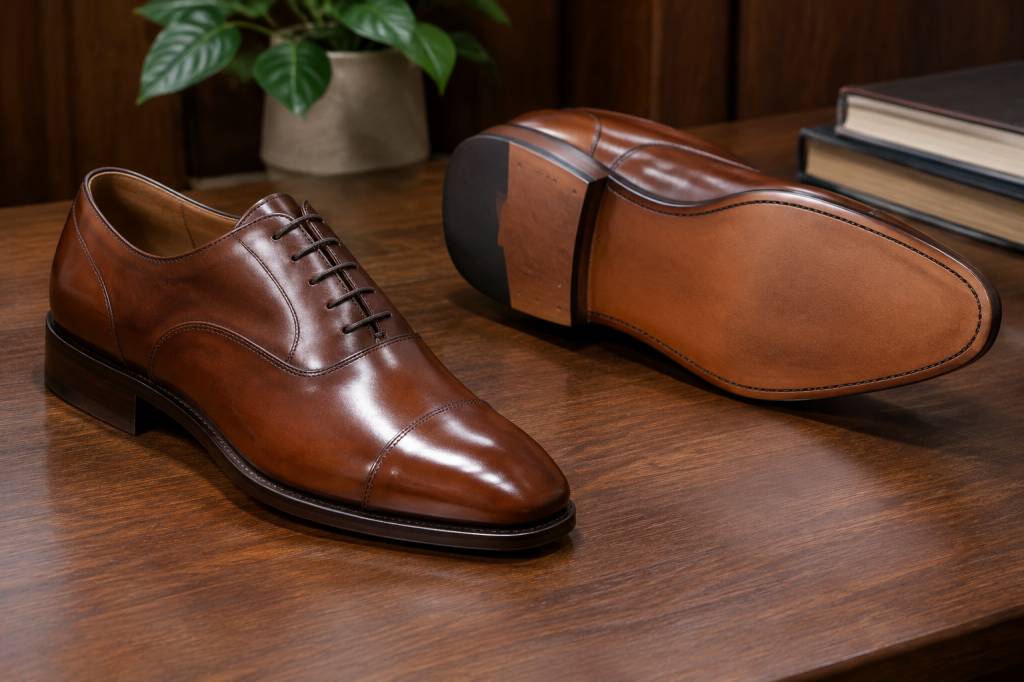
Some details in a dress shoe announce themselves at once: a polished toe, a handsome line of lacing, perhaps a rich shade of burgundy. Others wait patiently for you to look closer. The bevelled waist is one of those quieter details. It sits beneath the middle of the shoe, usually out of sight when you are standing, yet it can tell you a great deal about the shoe’s shape, construction and character.
I first noticed one while admiring a pair of handmade oxfords in a small shop where the owner treated every shoe as if it had a family history. I turned one over, and there it was: a slim, sculpted sole beneath the arch. “That,” he said, “is where the shoemaker shows his hand.” He was being a little theatrical, naturally. But he had a point.
So what exactly is a bevelled waist, and does it matter when choosing men’s dress shoes? Let’s take a closer look—without requiring you to lie down on the pavement to inspect anyone’s footwear.
What is the waist of a shoe?
The waist is the narrow section of the shoe’s sole between the broad forepart, where the ball of your foot sits, and the heel. Think of the sole as a simple outline: wide at the front, narrower through the middle, then broad again at the back. That pinched middle is the waist.
On many shoes, the waist is fairly flat and straightforward. On a more refined design, the sole edges slope inward towards the centre, creating a slimmer, more sculpted appearance. This shaping is called a bevelled waist. You may also hear people describe the waist as “bevelled” or “waisted”; the terminology can vary between makers and shoe enthusiasts.
The detail is easiest to see when the shoe is turned over, but its effect can also be noticed from the side. A well-shaped waist gives the sole a clean, elegant transition from the forefoot to the heel. It is a small flourish, rather like a neatly fitted jacket lining: not always visible, but pleasing when you discover it.
How is a bevelled waist made?
In traditional shoemaking, the waist is shaped through careful work on the sole. The shoemaker trims and contours the leather so the edges taper inward rather than remaining broad and flat. Depending on the construction and the maker’s methods, this shaping can be done by hand, by machine, or through a combination of both.
That last point matters. A bevelled waist is not, by itself, proof that a shoe is entirely handmade or exceptionally well made. It is a design and finishing detail, and its presence should be considered alongside the rest of the shoe: the quality of the leather, the construction, the stitching, the finishing and, most importantly, how it fits your foot.
Some makers take the sculpting further with a “fiddleback” waist. This has a raised ridge along the centre of the sole, giving it an outline that can resemble the back of a violin. A fiddleback waist is a particularly decorative treatment, while a bevelled waist generally refers to the sloping, narrowed edges. The terms are sometimes used loosely, but they are not always the same thing.
Why does it matter?
The simplest answer is appearance. A bevelled waist makes the underside of a shoe look slimmer and more graceful. It can complement a sleek Oxford or a refined dress boot, lending the whole shoe a more sculpted profile. Even if the sole is only glimpsed as you sit down or cross your legs, the detail adds a sense of intention.
It also reflects the maker’s attention to shaping and finishing. A beautifully contoured waist takes skill and time, especially when it is cut and finished by hand. That does not automatically make the shoe comfortable, durable or worth its price—but it may be one sign that the maker has paid attention beyond the obvious parts.
And then there is the pleasure of knowing the detail is there. Men’s style does not have to be a parade of loud logos and shiny buckles. Sometimes the best details are the ones discovered by someone who knows where to look. A bevelled waist is a quiet little handshake between the shoemaker and the wearer.
Does it improve comfort or support?
Here we should be sensible and separate beauty from biomechanics. A bevelled waist is primarily a feature of the sole’s shape and appearance. It does not automatically provide better arch support, improve posture or make a shoe more comfortable.
Comfort depends on several things: the shape of the last, the fit around the heel and forefoot, the flexibility of the sole, the cushioning, and whether the shoe suits your individual feet. If your arches need support, look at the shoe’s construction and insole, and consider advice from a qualified footwear professional. A handsome waist cannot negotiate with a painful bunion on your behalf.
The waist does form part of the sole, so its design contributes to the shoe’s overall structure. But it is unwise to assume that a narrower, more sculpted waist is inherently stronger or more supportive. Different makers achieve their results in different ways, and a refined appearance should not be confused with a medical benefit.
Does a bevelled waist make a shoe more durable?
Not on its own. Durability comes from the materials, construction, maintenance and the way you wear the shoe. A bevelled waist may be found on a carefully made shoe, but the shape itself does not guarantee that the sole will last longer.
When comparing shoes, check the sole and its attachment to the upper. Look at the quality of the leather, the neatness of the stitching and the maker’s information about resoling. If you plan to wear the shoes often, being able to replace the sole can matter far more than whether the waist has a dramatic curve.
And remember that leather soles need a little care. Let shoes rest between wears, use cedar shoe trees if you have them, and avoid leaving damp leather near a radiator. The radiator may be trying to help, but it has the subtlety of a Roman uncle giving relationship advice.
How to spot one when shopping
Many product photographs focus on the upper, leaving the sole hidden like a supporting actor who never makes the poster. If you are curious about the waist, look for a photograph of the outsole or ask the retailer. In person, turn the shoe over and inspect the narrow area between the ball and heel.
A bevelled waist usually has edges that slope inward, making the middle section appear narrower and more sculpted than a flat, straight-edged sole. Check the finish as well. The shaping should look deliberate and smooth, not irregular or roughly cut.
Here are a few useful points to keep in mind while you browse:
-
Compare the waist with the wider forepart and heel; the contrast is what makes the shaping noticeable.
-
Look for clean, even finishing along the sole edges.
-
Ask whether the waist is bevelled, fiddleback, or simply shaped to look narrow.
-
Consider the shoe’s fit and construction before paying extra for decorative details.
-
Check whether the sole can be repaired or replaced if you expect regular wear.
A shop assistant who knows the product should be able to explain the construction without turning the answer into a mysterious shoemaking riddle. If all you hear is “very premium, sir,” ask another question.
Which shoes suit a bevelled waist?
The detail is often associated with formal and dressier footwear: Oxford shoes, elegant Derbies, dress boots and some loafers. On a slim Oxford, the sculpted waist reinforces the shoe’s clean lines. On a chunkier casual shoe, it may be less noticeable—or simply not part of the design language.
That does not mean there is one correct style. A bevelled waist can look especially striking on a polished black Oxford, but it can also add refinement to brown calfskin or a dark suede dress shoe. The best choice depends on your wardrobe. If you wear suits several days a week, a sleek pair may earn regular outings. If your usual uniform is jeans and a casual jacket, a highly formal shoe might spend more time resting in the closet than enjoying its elegant waist.
Start with the occasions you actually dress for, not the imaginary life in which every Tuesday ends at a grand hotel dinner.
Can the detail make you look taller?
Not directly. A bevelled waist changes the appearance of the sole, but it does not add height in the way a raised heel or an elevator shoe does. It is a refinement, not a secret lift hidden in the arch.
Still, small design choices influence how a shoe looks on the foot. A sleek, well-proportioned shape can create a tidy line with your trousers, while a bulky sole may draw more attention downwards. The effect is subtle, and your trouser length, fit and overall proportions matter too.
If gaining a little height is your goal, choose shoes designed for that purpose and make sure they fit comfortably. Elevator shoes use an internal raised sole to add height discreetly. A bevelled waist may give a dress shoe a more elegant profile, but it should not be mistaken for a height-increasing feature. Style is happier when we ask each detail to do the job it was made for.
Is it worth paying more for?
That depends on what you value. If you enjoy fine shoemaking and appreciate details that reveal themselves on closer inspection, a bevelled waist may be part of what makes a pair special. It can be a lovely finishing touch and may accompany other signs of careful craftsmanship.
But do not let one detail make the decision for you. A comfortable, well-fitting shoe with sound construction is a better investment than an uncomfortable shoe with a waist worthy of an art gallery. Try both shoes on, walk around the shop, and check for pressure at the toes, slipping at the heel or pinching across the instep.
When the fit, construction and style are all right, the bevelled waist becomes a welcome bonus. It is the equivalent of finding a handwritten note tucked inside a beautifully wrapped gift: not the reason the gift works, but a charming sign of care.
A small detail with a lasting impression
The bevelled waist is a narrow, shaped section of the sole that gives a dress shoe a more sculpted appearance. It can show off a maker’s attention to detail, add elegance to the shoe’s profile and bring a little extra pleasure to anyone who appreciates the craft. What it cannot do, by itself, is guarantee comfort, durability or extra height.
Next time you are shopping for dress shoes, take a moment to look beneath the surface—literally. You may discover a detail you had never noticed before. And if you do, resist the urge to turn every shoe in the room upside down. Your curiosity is admirable; the shopkeeper’s patience may be less elastic.