
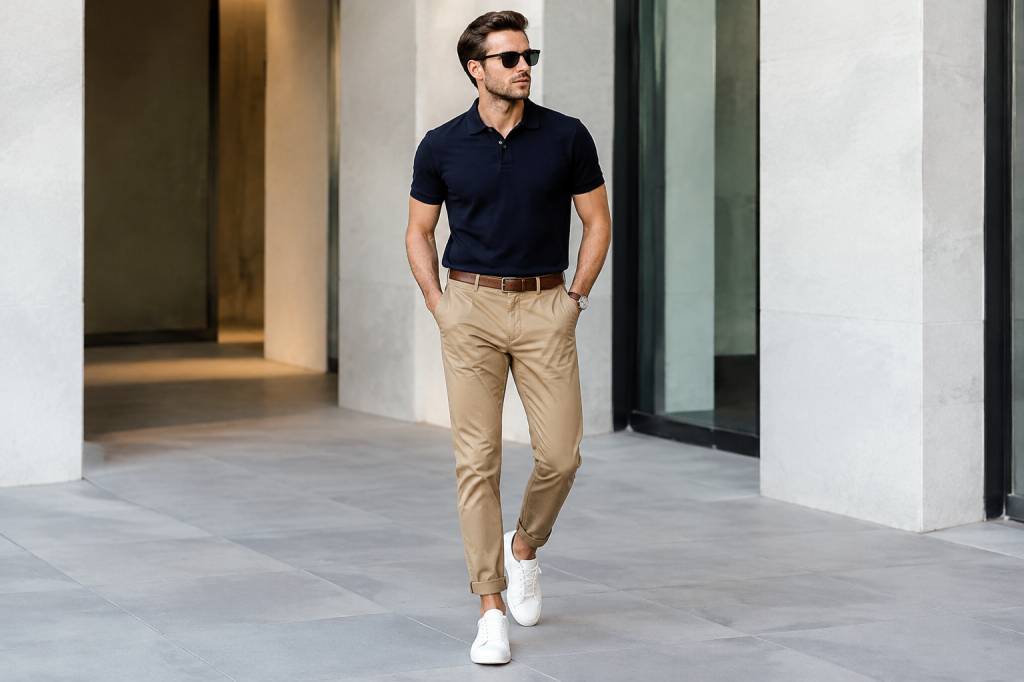
Khakis have a reputation for being dependable: the trousers you reach for when jeans feel too casual and dress pants feel like they expect a meeting. But add a sharp crease and a carefully chosen cuff, and they can do something more interesting: make your whole outfit look taller, cleaner, and more deliberate.
There is a small catch. Cuffs and creases can either help your proportions or interrupt them. The difference comes down to details such as cuff width, trouser length, color, and the shoes underneath. Get those right, and your khakis will look polished rather than fussy. Get them wrong, and the fabric may appear to stack around your ankles as if it has decided to settle in for the afternoon.
Here is how to style cuffed, creased khakis for a taller look without making the outfit feel like a geometry lesson.
Why cuffs and creases affect your proportions
A crease creates a vertical line down the front of each trouser leg. Because the eye naturally follows that line, a crisp crease can make your legs appear longer and your outfit more structured. It also helps khakis look smarter, especially when paired with a fitted shirt, a knit polo, or a casual blazer.
A cuff, on the other hand, adds a horizontal line at the ankle. That line can visually shorten the leg, particularly when the cuff is wide or contrasts strongly with your shoes. This does not mean you must avoid cuffs. It means they need to be proportionate and intentional.
Think of the crease as the road and the cuff as a small speed bump. A narrow, neat bump is easy to pass over. A bulky one gets all the attention.
Choose a cuff that does not overwhelm your frame
For a taller appearance, keep the cuff modest. A cuff around one to one and a half inches is a dependable starting point for most men. If you are shorter or have a slim build, lean toward the narrower end. A wide cuff can make the lower leg look heavier and draw the eye straight to the ankle.
Proportion matters more than following a rigid rule. The cuff should look balanced with the weight of the khaki fabric and the shape of your shoes. Lightweight chinos usually look best with a neat, narrow turn-up. Heavier cotton trousers can support a slightly more substantial cuff, though it should still feel refined rather than oversized.
Try the trousers on with the shoes you plan to wear. A cuff that looks perfect with loafers may sit differently over boots or elevator shoes. Stand naturally, walk a few steps, and check the side view. The cuff should sit cleanly without ballooning, twisting, or catching on the heel.
Get the trouser length right
Length is one of the most important parts of the outfit. Too much fabric creates folds above the cuff, breaking the clean vertical line of the crease. Too little length can expose too much sock or make the trousers appear accidentally cropped.
For a streamlined look, aim for a slight break or no break, depending on your shoes and personal style. A slight break means the front of the trouser leg makes a small, controlled fold where it meets the shoe. With a cuff, many men prefer a cleaner hem that rests just above the shoe without a deep stack of fabric.
When you visit a tailor, wear the shoes you expect to pair with the khakis. Ask for the trousers to be hemmed with the cuff included, not simply shortened as if they were going to remain uncuffed. That small instruction can save you from a hem that sits awkwardly once the turn-up is added.
And do not judge the length while sitting down. Trousers naturally rise when you sit. Check them standing, walking, and taking a step up. Your khakis should look composed in motion, not only in a fitting-room mirror.
Keep the crease sharp and straight
A crease works best when it runs cleanly from the upper leg toward the hem. It should not drift sideways or disappear into a mass of wrinkles near the ankle. Press the trousers carefully, following the existing crease, and use a moderate amount of steam rather than flattening the fabric with excessive heat.
If your khakis are made from a fabric that resists a permanent crease, a light press before wearing can still make a difference. A tailor can also help establish a crease that suits the cut. The goal is not to make casual trousers look like formal uniform pants; it is to give them enough definition to guide the eye vertically.
Pay attention to the fit through the thigh and lower leg, too. A crease cannot rescue trousers that are pulling across the thighs or bunching at the calves. A straight or gently tapered cut usually gives you a cleaner line than an extremely baggy pair.
Build a continuous color line
One of the easiest ways to look taller is to reduce abrupt color breaks. Try khakis in a shade close to your shoes, or choose shoes and trousers that sit within a similar color family. Tan khakis with medium brown shoes create a softer transition than tan trousers with very dark, high-contrast footwear.
This does not mean your shoes and trousers must match exactly. A little contrast adds personality. Just avoid making the ankle the most dramatic point of the outfit. If your trousers are pale stone and your shoes are black, the strong dividing line may draw attention downward. A dark brown shoe, warm burgundy, or a deeper tan can often feel more harmonious.
Socks can help bridge the gap. Matching your socks to your trousers creates a longer visual line when a small amount of sock shows. Matching them to your shoes can also work, especially with a more formal outfit. A bright, contrasting sock is fun, but it puts a spotlight on the ankle. Save that move for days when looking taller is not the priority.
Pick shoes that support the silhouette
Your shoes should complement the shape of the khakis, not compete with the cuff. A sleek loafer, a streamlined derby, or a simple leather sneaker can all work well. Shoes with a moderate profile tend to preserve a clean line, while very bulky soles may make the ankle area look heavier.
If you want extra height, elevator shoes can add lift while keeping the appearance of an ordinary, well-designed shoe. Look for a shape that suits the trousers: a clean toe, balanced proportions, and a sole that does not look exaggerated. The aim is to feel taller and more confident, not to announce the engineering beneath your feet.
When wearing elevator shoes with cuffed khakis, check the hem from the side. The extra height can change where the fabric falls, sometimes creating a longer-looking leg line and sometimes leaving the trousers too short. A well-fitted pair should sit neatly over the shoe without hiding its shape or bunching at the ankle.
My favorite combination for a relaxed evening is a tapered pair of khakis, a narrow cuff, and a simple leather shoe in a warm brown. It has the easy charm of a Mediterranean afternoon: polished, but not so polished that you look afraid to sit down for dinner.
Choose a cut that lengthens rather than widens
A slim-straight or gently tapered fit generally works well with cuffs and creases. The trousers should follow your shape without clinging. Too much width adds fabric around the lower leg, while an extremely tight fit can make the cuff look like an afterthought.
Look for a comfortable fit at the waist and seat, with enough room to move. The leg should fall cleanly from the knee to the ankle. If the fabric twists or catches around your calves, try another cut rather than relying on careful pressing to solve the problem.
Rise matters as well. A mid-rise trouser worn at the natural waist can make the legs appear longer than a low-rise pair sitting on the hips. Wear your shirt tucked in when appropriate, or choose a top that ends around the hip rather than covering most of the trousers. Showing more of the trouser rise helps the eye read the legs as longer.
Pair the khakis with tops that keep the eye moving
A fitted or neatly tailored top balances the clean lines of creased khakis. A tucked-in shirt, fine-gauge sweater, or well-cut polo keeps the waist visible and helps avoid a boxy silhouette. If you add a jacket, choose one that ends around the hip and fits cleanly through the shoulders.
Monochromatic or low-contrast outfits can also create a longer impression. Try olive khakis with a darker green knit, or sand-colored trousers with a cream shirt and a light tan jacket. The shades do not need to be identical; they simply need to work together without chopping the body into too many sections.
Vertical details help, too. An open jacket, a narrow tie, or a shirt placket can reinforce an upward-and-downward line. Keep patterns relatively restrained if your trousers already have a strong crease. A checked shirt, bold belt, contrasting socks, and oversized cuff all competing for attention can turn a simple outfit into a crowded little theater.
Use accessories with a light touch
A belt close in color to your khakis creates less contrast at the waist than a very dark belt. If you wear a belt, choose one that fits the formality of your shoes. A slim leather belt usually looks more natural with pressed khakis than a wide, heavily detailed one.
Keep the belt buckle understated. A large shiny buckle creates a horizontal focal point, while a simple buckle lets the outfit flow. The same principle applies to watches and bags: accessories should support your look, not interrupt it at every turn.
For a casual outfit, a tucked-in polo, brown leather belt, and tonal shoes can make cuffed khakis feel effortless. For a sharper setting, add a crisp shirt and an unstructured blazer. Either way, the goal is a clear line from shoulders to shoes.
Common styling mistakes to avoid
-
Oversized cuffs: Wide turn-ups can make the lower leg look shorter and heavier. Keep the cuff in proportion to your height, build, and trouser fabric.
-
Too much stacking: Excess fabric above the cuff weakens the crease and creates visual clutter. Have the length adjusted for the shoes you will wear.
-
High-contrast socks: Bright socks can divide the leg at the ankle. Choose a tone closer to your trousers or shoes when you want a longer line.
-
A baggy lower leg: Extra width can overwhelm a small cuff. Try a straight or gently tapered cut instead.
-
Overly bulky footwear: Heavy shoes may make the cuff and ankle area look crowded. Choose a shape that complements the trouser leg.
-
A crease that wanders: A crooked or poorly pressed crease distracts from the vertical line you are trying to create. Press along the natural grain of the trousers.
Three easy outfits to try
For a casual weekend: Wear stone khakis with a narrow cuff, a navy polo, and clean brown leather sneakers. Choose socks close to the trouser color, or no-show socks if the shoes allow. The restrained contrast keeps the look relaxed without cutting the leg line in half.
For a smart-casual dinner: Try olive khakis with a crisp white shirt, a slim brown belt, and streamlined elevator shoes in dark brown. Keep the cuff neat and the shirt tucked in. The darker shoes add polish, while their similar warm tone blends naturally with the trousers.
For a cool-weather look: Pair darker khakis with a fine knit sweater and a hip-length jacket. Wear a clean leather boot with a moderate sole. Make sure the trouser hem rests neatly over the boot rather than bunching heavily on top of it.
Make the details work together
The best cuffed, creased khaki outfit is not built around one magic trick. It is a collection of small decisions: a crease that draws the eye upward, a cuff that does not dominate, a hem that meets the shoe cleanly, and colors that connect rather than clash.
Before heading out, take one last look in a full-length mirror. Is the cuff neat? Does the trouser leg fall smoothly? Are your shoes helping the outfit feel balanced? If the answer is yes, you are ready. And if you feel a little taller in the process, consider that a welcome bonus from a pair of very well-behaved khakis.