







A sweater can look perfect on the hanger and still behave like a tiny woolly tent once you put it on. The shoulders droop, the sleeves swallow your hands, or the hem hangs low enough to compete with your coat. I know the feeling: years ago, I found a handsome navy sweater in a small shop in Florence. The color was beautiful, the price was kinder than expected, and the fit made me look as though I had borrowed it from a much taller cousin.
Fortunately, a sweater that fits poorly is not always a lost cause. With a few careful adjustments, you can improve its shape, make it more flattering, and get more wear from a piece you already own. The key is knowing what can be altered at home, what needs a tailor, and when the yarn itself is best left alone. Knitwear is charming, but it does not always forgive a heavy hand.
Start by identifying the problem
Before you reach for scissors or a sewing machine, put the sweater on over the kind of shirt you usually wear with it. Stand naturally, relax your arms, and look at the overall silhouette. A sweater should feel comfortable through the chest and shoulders, with enough room to move without billowing around the body.
Check each area separately. Are the shoulder seams sitting far beyond your shoulders? Do the sleeves cover your knuckles? Is the body too wide, too long, or both? Does the neckline gape? A clear diagnosis helps you choose a sensible fix instead of altering three things when one small adjustment would do the job.
It can help to take a quick photo from the front and side. Mirrors are useful, but a photograph often reveals proportions you miss while adjusting your collar or admiring your hair. Ask a trusted friend to pin the excess fabric while you wear the sweater. Do not pin it so tightly that the knit stretches; the goal is to mark a comfortable fit, not to create a new shape by force.
Know what kind of sweater you have
Not all sweaters are built alike. A fine-gauge cotton or wool sweater may be stable enough for careful hand sewing. A chunky cable knit, loosely knitted cardigan, or delicate cashmere piece can be much harder to alter because its stitches are visible and may unravel if cut.
Look at the seams and edges. A sweater with side seams and set-in sleeves is generally easier to reshape than a seamless garment knitted in one piece. Ribbed cuffs and hems are also important: they are designed to stretch and recover, so shortening a sweater through the ribbing can take patience and some knitting skill.
Check the care label before you begin. Natural fibers can shrink or felt when exposed to heat, agitation, or the wrong washing method. If you are unsure whether the sweater is wool, cotton, acrylic, or a blend, treat it gently. A little caution is less expensive than learning the hard way that your favorite pullover now fits a very stylish teddy bear.
Try simple styling fixes first
Sometimes the best alteration is no alteration at all. If the sweater is only slightly long, try a neat front tuck into your trousers or jeans. A small tuck can define the waist and make the legs appear longer, while leaving the back loose for an easy, relaxed shape. Avoid pulling the sweater into a thick knot of fabric; the result should look intentional, not like you lost a wrestling match with your waistband.
For sleeves that are a little too long, fold the cuffs once or twice. This works especially well when the sweater has a ribbed cuff that holds its shape. If the fabric is bulky, however, repeated rolling can create a heavy band at the wrist. In that case, a single soft fold—or a tailor’s adjustment—will look cleaner.
Layering can also help. A shirt collar or a contrasting T-shirt hem can make a roomy sweater look deliberate, while a fitted base layer reduces bulk. These tricks cannot fix a dramatically oversized garment, but they can make a mildly imperfect fit feel like a considered style choice.
Shorten long sleeves carefully
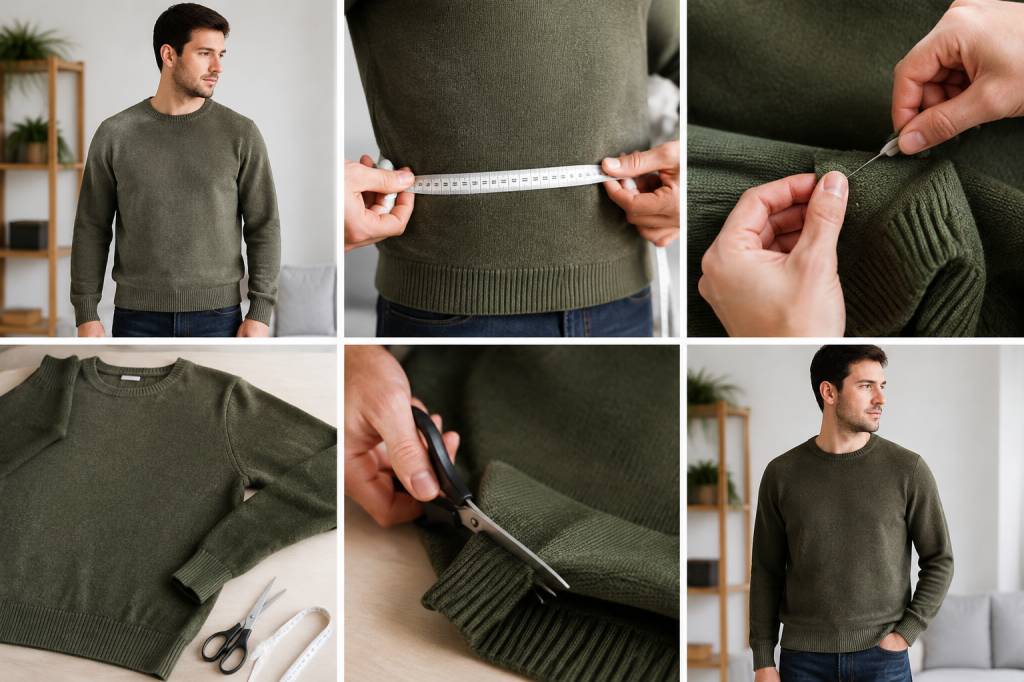
Long sleeves are among the most common sweater problems, and they are often manageable. First decide where you want the cuff to sit. For a classic fit, the cuff usually reaches the wrist bone without covering the hand. Mark the desired length with small clips or pins while wearing the sweater, then take it off and measure both sleeves. Arms are not always identical, so do not assume the same measurement will look right on each side.
If the sweater has a separate ribbed cuff, a skilled tailor may remove it, shorten the sleeve, and reattach the cuff. This preserves the finished edge and usually looks more professional than simply cutting off the excess. Ask whether the tailor works with knitwear specifically; altering a sweater is different from shortening a woven shirt sleeve.
For a simple, stable knit, you may be able to shorten the sleeve by folding the excess fabric inside and securing it with small hand stitches. Use a fine needle and matching thread. Catch only a few yarn loops at a time, and keep the stitches loose enough for the fabric to stretch naturally. Try the sweater on before trimming anything. In fact, for a first attempt, do not trim at all: a concealed fold is reversible, while a cut edge may unravel.
Take in a sweater that is too wide
If the body is too roomy, taking in the side seams can improve the shape. Turn the sweater inside out and put it on carefully, or use a well-fitting sweater as a guide. Pin a small amount along each side seam, tapering smoothly from the underarm toward the hem. Keep the adjustment modest. Removing too much fabric can make the sweater pull across the chest or twist around your body.
For hand sewing, use a fine needle and thread that matches the yarn. Work along the existing seam where possible, catching the knitted loops rather than making large stitches through the fabric. Small, flexible stitches are essential because sweaters stretch when you move. After sewing a short section, try the sweater on and raise your arms. If the seam feels tight, unpick it and allow more room.
A sewing machine can be used on some stable knits, but it is not the best choice for every sweater. A narrow zigzag stitch can allow more stretch than a straight stitch, yet the machine may snag or flatten delicate yarn. Practice on an inconspicuous area or a spare piece of similar knit first. If the sweater is expensive, sentimental, or visibly textured, take it to a professional.
What to do about a sweater that is too long
Length is trickier than width because the hem is often finished with ribbing. Cutting across the body and turning up a new hem may remove that ribbed finish, change how the sweater hangs, or cause the stitches to unravel. That is why shortening a sweater is usually a job for a knitwear alteration specialist or an experienced tailor.
One option is to shorten the body from above the ribbed hem, then reattach the original hem. The result can look excellent, but it requires opening and securing knitted stitches with care. Another approach is to use a small internal fold, hand-sewn on the inside. This is less permanent and can work when only a little length needs to come off, though it may add bulk.
Before choosing either method, think about proportion. A sweater that looks long when worn loose may look balanced with a front tuck or higher-rise trousers. If you wear elevator shoes or boots with a substantial sole, a cleaner, shorter sweater silhouette can help keep your outfit balanced from head to toe. Clothing proportions are a quiet kind of visual magic: no dramatic transformation required, just a few thoughtful lines.
Can you shrink a sweater to improve the fit?
People often ask whether washing a sweater in hot water will make it smaller. The honest answer is that it might, but it may also make it stiff, misshapen, or several sizes too small. Wool can felt under heat and agitation; cotton and synthetic blends behave differently, and the outcome is difficult to control. Shrinking is not a dependable alteration technique.
If a wool sweater is only slightly loose, follow its care label and wash it gently. Lay it flat on a clean towel, shape it to the dimensions you want, and let it dry naturally. This process is called blocking. Blocking can even out a garment or encourage a gentle change in shape, but it cannot reliably turn an oversized sweater into a fitted one.
Never put a sweater in a hot dryer as an experiment unless you are entirely prepared to lose it. The dryer does not understand your tailoring plan. It simply gets warm and makes its own decisions.
When to call a professional
Take the sweater to a tailor or knitwear repair specialist if it has no obvious seams, an intricate cable pattern, delicate cashmere, a complex neckline, or a large amount of excess fabric. Professional help is also wise when the shoulders need reshaping. Shoulder fit affects the entire garment, and moving a sleeve or changing the armhole can be complicated.
Bring the sweater with the shirt or base layer you plan to wear underneath. Explain what feels wrong and show the tailor where you would like the hem or cuffs to sit. Ask for the price before work begins and whether the proposed alteration will preserve the original finish. A good specialist will tell you if the change is not worth the cost or could damage the knit.
Make the fit last
Once your sweater fits better, care for it in a way that helps it keep its shape. Follow the label, wash it only when needed, and avoid hanging heavy knits on narrow hangers. The weight of the fabric can pull the shoulders out of shape. Fold sweaters and store them flat, especially during warmer months.
For small snags, resist the urge to cut the loose yarn. Use a blunt needle or a crochet hook to pull the loop through to the inside, then smooth the surrounding stitches gently. If the knit has a hole or a ladder of dropped stitches, repair it promptly before it grows into a larger problem.
A well-fitting sweater should make you feel at ease, not make you think about tugging at the sleeves every five minutes. Start with the smallest fix, work slowly, and ask for professional help when the construction calls for it. Whether you are adjusting a beloved old cardigan or rescuing a bargain from the sale rack, a few careful choices can turn “almost right” into a piece you reach for all season.