






You find a suit that looks perfect on the hanger: sharp lapels, a rich navy color, and just enough Italian flair to make you feel like you should be stepping onto a film set. Then you spot two options: 40R and 40S. Same number, different letter. Which one belongs in your wardrobe?
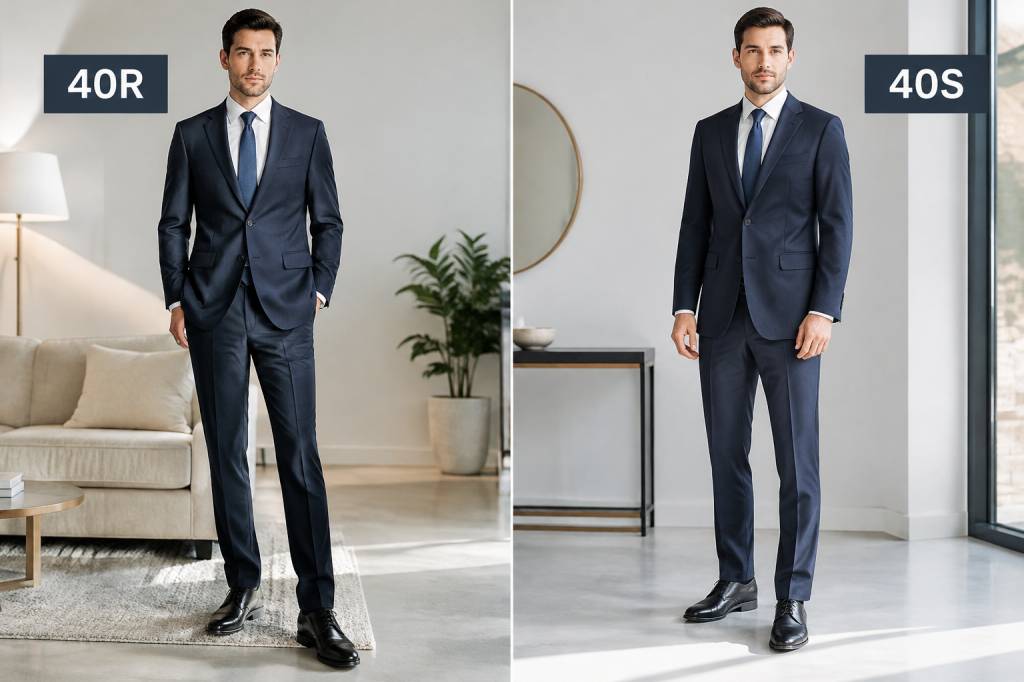
The short answer: both jackets are designed for a 40-inch chest, but the letter describes the jacket’s length and the proportions that usually suit the wearer. “R” means Regular; “S” means Short. Choose the wrong one and the jacket may pull, sag, or make your proportions look a little off. Choose well, and even an ordinary Tuesday can feel like a very good occasion.
What 40R and 40S Actually Mean
The number in a suit size refers to the jacket’s chest measurement. A size 40 is generally intended for someone with a chest measuring about 40 inches, though the fit will vary by brand and cut. The letter refers to the jacket’s length category:
- 40R: a size 40 jacket in Regular length.
- 40S: a size 40 jacket in Short length.
In most suit ranges, a Short jacket is a little shorter through the body and sleeves than the same size in Regular. The difference is usually around an inch, but manufacturers do not all follow exactly the same measurements. The shoulder width, chest, and waist may also be proportioned slightly differently to suit the intended wearer.
So, 40S is not a smaller chest size than 40R. If the chest is right but the jacket looks too long, Short may be worth trying. If a Short jacket looks cropped or the sleeves sit too high, Regular may be the better choice.
Who Should Usually Choose 40S?
A 40S is often a good starting point for a man with a 40-inch chest who is on the shorter side. Many brands suggest Short for men around 5 feet 7 inches or below, but height is only a rough guide. Your torso length, arm length, shoulder position, and the way you like a suit to fit matter just as much.
Imagine two men who are both 5 feet 8 inches tall. One has a longer torso and shorter legs; the other has a shorter torso and longer legs. The first may find a Short jacket sits neatly, while the second may prefer a Regular. We are not all built to the same blueprint, thankfully—otherwise fitting rooms would be even more depressing.
Consider 40S if you commonly find that:
- Regular jackets extend too far below your seat.
- The sleeves cover too much of your shirt cuff.
- The jacket makes your legs look shorter than they are.
- The buttoning point sits unusually low on your torso.
A Short jacket can make your overall silhouette feel better balanced. Its hem and button position may sit closer to where they are intended, rather than making your frame appear overwhelmed by fabric.
Who Should Usually Choose 40R?
A 40R is often a sensible choice for men of average height, commonly somewhere around 5 feet 8 inches to 6 feet, depending on the brand and body shape. If Regular jackets usually give you the right sleeve length and body coverage, there may be no reason to change simply because another size sounds more tailored.
Try a 40R if a 40S makes the jacket look too short, the sleeves reveal too much of your forearms, or the hem ends noticeably above your seat. A jacket that is too short can look like it belongs to your younger cousin—and not in a charming way.
Tall men may need a Long size rather than Regular. If the available choices are only 40S and 40R, and both seem short in the sleeves or body, it may be worth looking for a 40L or a different brand. Do not assume that sizing up to 42 will solve a length problem: the chest and shoulders may become too large while the jacket remains the wrong length.
How to Check the Fit in a Fitting Room
Try both sizes if you can. Wear a dress shirt similar to the one you plan to wear with the suit, button the jacket, and stand naturally. Do not pull your shoulders back like you are posing for a portrait painted by a distant relative. You want to see how the jacket behaves in real life.
- Check the shoulders. The shoulder seams should sit close to the ends of your shoulders. Excess fabric, dents, or a seam that hangs beyond your shoulder can signal a poor fit.
- Check the chest. Button the top button on a two-button jacket. You should be able to move comfortably, without a strong X-shaped pull across the front.
- Check the sleeves. The jacket sleeve should generally show a small amount of shirt cuff, often around a quarter to half an inch. Your arm length and the shirt sleeve both affect this.
- Check the jacket length. The hem should look balanced with your body. A traditional guide is that the jacket covers the seat, though modern cuts can be shorter.
- Check the buttoning point. The button should not sit so low that the jacket seems to drag your torso downward, or so high that it feels cramped.
Then move. Sit down, reach forward, and walk a few steps. A suit is clothing, not a decorative tent. If the jacket feels restrictive when you move normally, a mirror’s flattering lighting will not save it.
Why Height Alone Does Not Decide It
Height is useful as a first clue, but it cannot tell the whole story. A man who is 5 feet 9 inches may have long arms and need Regular sleeves, while another man of the same height may have a shorter torso and look better in Short. Posture also changes how a jacket appears. Rounded shoulders or a forward head position can make the front hem seem longer or the back seem uneven.
Body shape matters, too. A broad chest with a narrow waist may need a different cut from a straighter build, even when both wear a size 40. Suit sizing is a starting point, not a verdict from a tailor in a courtroom wig.
When shopping online, measure a jacket you already like. Lay it flat and compare its shoulder width, chest, sleeve length, and back length with the retailer’s size chart. Measurements are more reliable than assuming every 40R—or every 40S—will fit exactly the same.
Can a Tailor Fix the Wrong Size?
A tailor can make many useful adjustments. Sleeves can often be shortened, the waist can be taken in, and small changes to the jacket’s shape may improve the fit. These alterations can turn a decent suit into a very good one.
But tailoring has limits. Shortening a jacket body is more complicated than shortening trousers and can disrupt pocket placement, button position, and overall proportions. Adding length is usually difficult unless there is spare fabric inside, and even then the result may not be ideal. Shoulder alterations are also expensive and technically demanding.
For that reason, get the shoulders and overall jacket length as close as possible before buying. A little sleeve work is routine; rebuilding a jacket is a project. If the 40S fits your chest but looks dramatically short, and the 40R fits your chest but looks too long, try another cut or brand before reaching for your wallet.
Choosing a Suit to Look Taller
For readers who enjoy a little extra height in their style, the right jacket length can help create a cleaner visual line. A jacket that is too long may make the legs look shorter; one that is too short can throw the proportions off in the opposite direction. The goal is balance, not an optical illusion worthy of a stage magician.
A well-fitting suit can work nicely with elevator shoes, too. The shoes add discreet height, while the suit should fall naturally over them. Keep the trousers long enough to meet the shoe with a slight break, or choose a cleaner, shorter break if that suits the cut. Trousers that stack heavily at the ankle can hide the line of the shoe and make the whole outfit look untidy.
Try to keep the outfit visually streamlined. A jacket and trousers in similar shades can create a continuous line, while a close match between your belt and shoes keeps things tidy. These details will not change your measurements, of course, but they can make the overall look feel taller and more composed.
A Simple Way to Make Your Choice
Start with your chest measurement and try a size 40 in the cut you like. If the chest and shoulders fit, compare the 40S and 40R for sleeve length, body length, and the position of the buttons. Choose the one that looks balanced when you stand and still feels comfortable when you move.
If you are between lengths, think about your proportions rather than chasing a number on a tag. A shorter man with long arms may prefer Regular; a taller man with a shorter torso may find Short more flattering. And if neither option fits well, that is not a failure on your part. It simply means the brand’s pattern was not drawn for your particular shape.
The best suit is not the one with the most impressive letter. It is the one that lets you forget about the tag, stand comfortably, and enjoy the evening. Choose 40S for a shorter, more balanced fit; choose 40R when you need the extra length. Then finish the look with polished shoes, an easy smile, and the confidence of a man who knows his jacket is working with him—not against him.