





A good suit can sharpen your silhouette, a well-chosen pair of elevator shoes can add discreet height, and the right mirror can reveal whether everything truly works together. Yet mirrors are often an afterthought: we buy one because it fits a wall, then wonder why our trousers look balanced at home but oddly short in the office changing room.
A tailor’s mirror is more than a full-length sheet of glass. Its height, angle, lighting, and placement all affect how you see your proportions and the fit of your clothes. Choose carefully, and it becomes a practical styling tool. Choose poorly, and it may flatter you in ways your hallway, office, or next photograph will not.
What Makes a Mirror a Tailor’s Mirror?
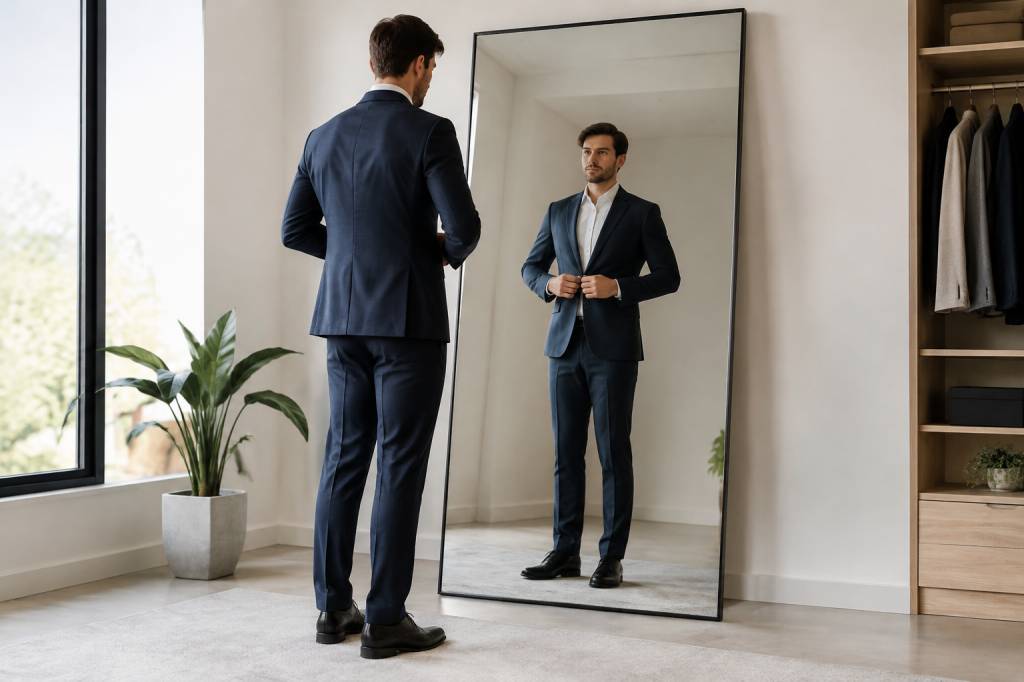
A tailor’s mirror is a full-length mirror designed to show your outfit from head to toe with as little distortion as possible. Tailors use mirrors to help clients assess the fit and balance of garments, but the same idea is useful at home. You can check a jacket’s shoulder line, the break of your trousers, and whether your shoes complement the whole look.
The key is seeing your body and clothing in realistic proportions. A mirror that is too short may hide your shoes. One that leans at an awkward angle can make your legs appear longer or shorter. And poor lighting can turn a deep navy suit into something that looks suspiciously black.
Think of it as part of getting dressed, not merely part of decorating. A mirror should help you answer a useful question: “Does this outfit fit and look balanced when I stand naturally?”
Choose the Right Height and Width
For a useful full-length view, choose a mirror tall enough to show your entire reflection, including your shoes, without forcing you to stand far away. A mirror around 60 inches tall works for many people, while a taller option gives more flexibility. If you are tall, measure your own reflection before buying rather than trusting the phrase “full length” on a product page.
Width matters, too. A narrow mirror may be fine for checking a tie, but it makes it harder to see the outline of a jacket or the way a coat hangs when you turn slightly. A wider mirror gives you room to inspect your silhouette from more than one angle.
Before shopping, mark out the mirror’s dimensions on a wall with removable tape. Stand where you would normally get dressed and check whether the outline gives you enough space to see your outfit comfortably. This simple test can save you from discovering that your elegant new mirror provides a perfect view of your left sleeve and very little else.
Look for an Undistorted Reflection
Not all mirrors show the same reflection. Thin glass, a warped backing, or an uneven frame can bend straight lines and subtly alter your proportions. You might not notice the effect at first, but a jacket seam that appears crooked or a trouser leg that seems uneven can make a fitting check unnecessarily confusing.
When possible, inspect the mirror in person. Look at the vertical edges of a door or window reflected in it. If those lines curve, wobble, or lean when they should be straight, choose another mirror. Online, look for clear product details about glass thickness and construction, and check customer photos for signs of distortion.
A small amount of perspective change is normal if you stand very close or at a steep angle. For the most reliable view, place the mirror vertically and stand several feet away. You want to assess the outfit, not investigate the optical mysteries of your bedroom.
Pay Attention to the Angle and Mounting
A wall-mounted mirror installed vertically usually gives the most dependable view of how clothes fit. A mirror that leans backward can change the apparent length of your legs and the proportions of your torso. That may be welcome when you are taking a quick outfit photo, but it is less useful when deciding whether your trousers need adjusting.
Floor mirrors can be convenient, especially in a rented home where drilling is not an option. If you choose one, make sure it is designed to stand securely and that its angle is adjustable or close to vertical. Follow the manufacturer’s instructions, and use a safety strap if the design recommends one. A mirror should help you dress with confidence, not become an unexpected guest on the floor.
For a wall-mounted mirror, place it where you naturally get dressed. If you have to move a laundry basket, open a door, and perform a small dance to see your shoes, you will probably stop using it properly. A good tailor’s mirror earns its place through everyday convenience.
Get the Lighting Right
Lighting can make an excellent mirror seem unreliable. A single overhead bulb may cast shadows under your eyes and change the appearance of fabric colours. Very warm light can make grey look brown; cool, bluish light can make skin and clothing appear harsher than they do outdoors.
Whenever possible, position your mirror near natural light, but avoid placing it where direct sunlight causes glare. If the room is dim, use balanced lighting around the mirror rather than relying only on a bulb directly above your head. The goal is an even view of your face and clothes, without deep shadows or dramatic highlights.
There is a reason dressing rooms use several lights: a suit needs to look right from more than one direction. At home, even a well-placed lamp can help you see whether a jacket fits smoothly across the chest or whether a shirt colour works with your complexion. Check important outfits in both your usual indoor lighting and daylight when you can.
Use the Mirror to Check Fit, Not Just Appearance
It is tempting to look in the mirror, decide that an outfit feels “off,” and change everything. Instead, inspect one detail at a time. Start with your jacket: do the shoulders sit naturally, without obvious dimples or pulling? Does the front close comfortably? Are the sleeves the right length for your shirt cuffs?
Next, check your trousers. The waistband should sit comfortably, and the fabric should fall without excessive bunching. Look at the hem with the shoes you plan to wear. The same trousers may break differently over sleek dress shoes than over bulkier boots, so try the complete outfit rather than judging the trousers alone.
Finally, turn slightly to each side. A frontal view can hide wrinkles across the seat of the trousers or a jacket that pulls at the back. Stand naturally, with your shoulders relaxed. There is no need to pose like a statue in a tailor’s window; the point is to see how the clothes behave when you actually move.
Check Your Shoes and Overall Proportions
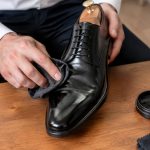
Shoes are the foundation of an outfit in both senses of the word. Their shape, colour, and sole height affect the balance of your look, especially when paired with trousers. A slim trouser leg may suit a streamlined shoe, while a heavier hem can look more harmonious with a sturdier style.
If you wear elevator shoes, use the mirror to assess the whole silhouette rather than focusing only on the extra height. Choose trousers with a clean drape over the shoes, and check that the hem does not catch or stack awkwardly. A discreet lift works best when the shoe looks like a natural part of the outfit. The mirror is your ally here: it lets you see whether the proportions feel polished from head to toe.
Try your usual combinations together. Put on the shoes, trousers, and jacket you intend to wear, then step back. Do the colours connect? Does the trouser length work with the shoe profile? Does the outfit still feel like you? A mirror cannot choose your personal style, but it can help you spot when one piece is interrupting the conversation.
Consider a Second Viewing Angle
One mirror gives you a useful front view, but tailoring is three-dimensional. If space allows, use a second mirror at an angle to check your side and back. This is particularly helpful when assessing a new jacket, a long coat, or trousers that need alterations.
You do not need to build a dressing room worthy of a film star. A small handheld mirror can help you inspect the back of a collar or the fit across the shoulders. You can also place a second mirror opposite the main one, provided it does not create confusing reflections or clutter the space.
When you check the back, look for practical signs: a collar that lifts away from the neck, fabric that pulls across the shoulders, or folds that appear when you stand normally. If something seems wrong, take a clear photo and ask a tailor for advice. A mirror can reveal a problem; an experienced tailor can tell you what to do about it.
Choose a Style That Suits Your Space
A tailor’s mirror should be useful, but there is no reason it cannot look good. A simple framed mirror can suit a traditional bedroom, while a frameless design may feel cleaner in a modern space. A full-length floor mirror can make a small room feel more open, especially when placed to reflect light rather than a pile of unpaired socks.
Think about the frame, too. A very thick frame reduces the visible glass area and may make a narrow mirror feel even narrower. A sturdy frame can add character, but the reflection should remain the star. Choose materials and colours that work with your furniture without making the mirror difficult to move or secure.
If your room is compact, a door-mounted mirror may be a practical choice. Check that it does not interfere with the door’s movement and that it is firmly attached. A wall-mounted option can save floor space, while a leaning mirror offers flexibility if you may rearrange the room later.
A Simple Mirror Check Before You Leave
Once your mirror is in place, make a short routine of using it. Put on the complete outfit, including the shoes and belt you plan to wear. Stand back far enough to see your full reflection, then check the front, sides, and back if possible. Look for fit and balance before worrying about tiny details.
- Check that your jacket sits smoothly at the shoulders and closes comfortably.
- Make sure your trouser hem works with the shoes you are wearing.
- Look for twisting seams, pulling fabric, or unexpected wrinkles.
- Check your outfit in natural or balanced light.
- Move naturally: sit, walk, or raise your arms to see whether the clothes stay comfortable.
Then ask yourself one final question: would you feel comfortable wearing this outfit into the room? If the answer is yes, you are probably ready. If not, identify the specific issue instead of changing everything in a last-minute panic. Sometimes the solution is a different belt; sometimes it is a tailor. Occasionally, it is simply standing up straight and giving the jacket a fair chance.
Make Your Mirror Work for You
The right tailor’s mirror is tall enough to show your full outfit, wide enough to reveal its shape, and clear enough to reflect it honestly. Good placement and balanced lighting make that reflection more useful, while a second angle can help you catch details you might otherwise miss.
Most importantly, use the mirror to make practical decisions, not to chase an impossible ideal. Clothes should fit your body and support your personal style. When your reflection shows a balanced outfit, comfortable movement, and shoes that finish the look, you have done more than check your appearance. You have made getting dressed feel a little easier—and perhaps added a touch of Italian confidence to the day.